The Impact of Online News Media
Death of The Newspaper
In the midst of new media technologies, print versions of newspapers are becoming increasingly less popular due to the consumption of news on the Internet. Online newspapers have found their niche among newshounds, the tech savvy and especially young people who view the Internet as a viable means of obtaining information and news. The Internet is a news medium that is ideal for people who have skills beyond television. An online journal is not as simple as a broadcast or print translation of it (due to its tendency to combine multiple forms of media). Even if it contains the same news and information from television, online is still such a relatively new platform that a large percentage of users are inexperienced.

The fall of the printing industry is old news. Regardless of what indicator we analyze (sales / circulation, income, number of active journalists, number of active newspapers or advertising revenue), we are forced to conclude that newspapers are in a life-threatening situation. In the era of the Internet and the rapid growth of social networking sites, print newspapers must compete with alternative advertising and communication models, arouse more interest from readers and cope with new problems such as significant reductions in revenue.
The History of Online Journalism
It is believed that by the time the first commercial web browsers, Netscape Navigator (1994) and Internet Explorer (1995), digital online journalism had expanded significantly. In 1996, most major media outlets were online. Since the late 1990’s, the growth in readership and development has been impressive with most medium and small-sized newspapers existing online. In addition, many radio and television stations began to offer some form of a news site on the Internet.

In the year 2000, one in four Internet users read the news online. With many of them reading it daily or weekly it became a widely used news medium. Its popularity survived the dotcom collapse of 2000/2001 and the number of readers only further increased during the war in Iraq. The desire for “as-it-happens” news created a demand for supplements for television and the written press, in particular among the readers at work. Despite the dramatic growth, or perhaps because of this, the factors that affect the quality of online newspapers are only partially understood. Since then, the use of online journalism as the main source of information has grown steadily. Whether through mobile phones, laptops or smart watches, technology has integrated the online medium with ease.
Impact
The estimated total circulation of US newspapers has steadily declined since the late 1980s’, from about 63 million to 31 million today. The number of newsroom staff has been reduced to 39,210, from 74,410 in 2006. More shockingly, advertisement revenue has plunged from $49 billion in 2005 to $ 17 billion in 2017).
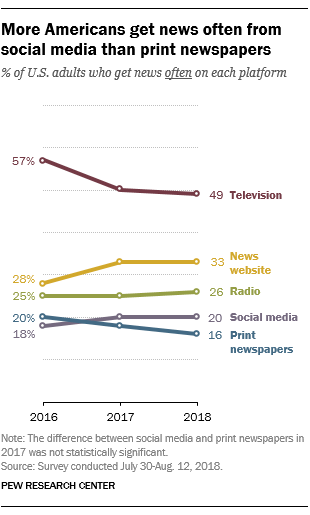
One in five American adults report that they often get their news via social media, slightly higher than the percentage that often does in print newspapers (16%). In 2017, the party that received news via social media was about equal to the party that received news from print newspapers. According to a Pew Research Center survey conducted earlier this year, the small advantage of social media over the print media has emerged after years of steadily declining newspaper circulation and modest increases in the proportion of Americans who use social media. Overall, television is still the most popular platform for information consumption – although its use has declined since 2016. News sites are the second most common source, followed by radio, and finally social media sites and printed newspapers. When we look at the use of online news combined – the percentage of Americans who often receive news from news websites or social media – the Web has caught up with television as a primary source of news ( 43% of adults often get news from websites or social media, compared to 49% for television).

Ethical/Moral Implications
Paradoxically, the decline of printed newspapers reminds us of their importance. Printed and online newspapers provide information to citizens, mobilize groups around issues and serve as guardians against bad actions or injustice. Researchers have linked the decline of local news to the reduction of citizen participation in politics. In the same vein, Robert Putnam’s survey of civic participation in Italy, Making Democracy Work, shows that the regions with the highest levels of newspaper readers were the same areas in which a strong civic community was standard. In addition, the rise of online media has fueled a revival of yellow journalism. Throughout the 2016 elections, the word “fake news” appeared. With the ability for anyone to create a website like this, there are hundreds of thousands of media sources that may or may not be reliable. When advertising revenue is determined by the number of people who view your article, honest journalism is no longer the primary goal. Using sophisticated algorithms to access millions of subscribers, the company has a simple goal: to encourage “viral information” that offers enough clicks to activate digital advertising. It does not matter whether the information is ethical, true or honest; What matters is if it is sensational, provocative and stimulating enough to attract attention. As the company continues to grow, it will be less important to know how we receive our news, and more important the tracking of countless newspaper articles on the Web to ensure that the public receives accurate and important information.

Work Cited
Demographics of Social Media Users and Adoption in the United States. (n.d.). Retrieved from http://www.pewinternet.org/fact-sheet/social-media.
Digital journalism. (2019, November 27). Retrieved from https://en.wikipedia.org/wiki/Digital_journalism.
Gottfried, J., & Shearer, E. (2017, September 7). Internet closes in on TV as a source of news in U.S. Retrieved from http://www.pewresearch.org/fact-tank/2017/09/07/americans-online-news-use-vs-tv-news-use/.
Hayes, D., & Lawless, J. (n.d.). The Decline of Local News and Its Effects. Retrieved from https://www.journals.uchicago.edu/doi/10.1086/694105.
Mitchell, A. (2019, September 17). Americans Still Prefer Watching to Reading the News – and Mostly Still Through Television. Retrieved from http://www.journalism.org/2018/12/03/americans-still-prefer-watching-to-reading-the-news-and-mostly-still-through-television/.
Tavares, R. (2019, February 21). How can newspapers survive? By measuring their social impact. Retrieved from https://www.weforum.org/agenda/2019/02/how-can-newspapers-survive-by-measuring-their-social-impact/.
The effects of online newspapers on the printed version. (n.d.). Retrieved from https://www.academia.edu/6146260/THE_EFFECTS_OF_ONLINE_NEWSPAPERS_ON_THE_PRINTED_VERSION.Trends and Facts on Newspapers: State of the News Media. (2019, July 9). Retrieved from http://www.journalism.org/fact-sheet/newspapers/.
Follow My Blog
Get new content delivered directly to your inbox.
 Austin Lee's Impact Project